In Texas, you can turn left on red only when turning from a one-way street onto another one-way street, as permitted by Texas Transportation Code §545.152. At all other intersections, turning left on red is illegal and a Class C misdemeanor punishable by fines up to $200.

A left turn on red is legal in Texas in one narrow situation: when you are turning from a one-way street onto another one-way street. Texas Transportation Code §545.152 carves out this exception to the general rule that a red light requires you to remain stopped.
The street you are leaving must be one-way in your direction of travel, and the street you are entering must be one-way in the direction of your turn. Both conditions have to be true at the same time. If either street allows traffic in two directions, the turn is illegal regardless of how clear the intersection looks.
The exception is narrow because Texas treats it as a privilege built into the code, not an automatic right. A driver who misreads the streets and turns anyway has committed a Class C misdemeanor and exposed themselves to liability for any crash that follows.
A left turn on red is only legal in Texas when all four of these conditions are met. Miss anyone and the turn is illegal, whether or not a crash follows.
The order does not matter, but the completeness does. A driver who stopped fully but turned onto a two-way street still committed the violation. So did the driver who turned from one one-way onto another but failed to yield to a pedestrian in the crosswalk.
A left turn on red is illegal in Texas at every intersection that does not meet the one-way to one-way exception under §545.152. The default rule is that a red signal requires you to remain stopped, and the burden is on the driver to confirm the exception applies before moving.
The most common situations where a left turn on red is always illegal:
If you turned left on red at any of these situations, the violation is the turn itself. The citation does not depend on whether you stopped or whether the intersection was clear.
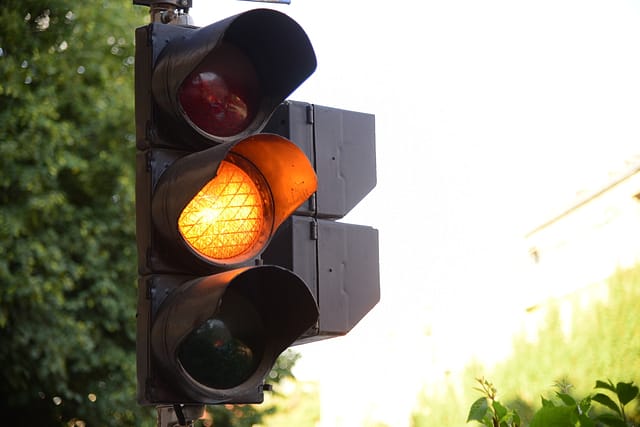
An illegal left turn on red in Texas is a Class C misdemeanor with fines up to $200 under Texas Transportation Code §545.401. Court costs and administrative fees push the total above $300 in most cities, depending on the driver’s record and whether the violation caused a crash.
Texas uses a points-based system through the Department of Public Safety. Moving violations add points to your driving record, and accumulating points can lead to insurance premium increases. Insurers typically raise rates after two or more moving violations within 12 months, and the impact compounds with each additional violation.
When the illegal turn causes a crash, the penalty climbs. Prosecutors can add reckless driving charges if injuries are involved, and your civil exposure is separate from the criminal fine and usually much higher. Commercial drivers also face possible CDL suspension after two serious violations in three years.
No, you cannot turn left on a red arrow in Texas, even at a one-way to one-way intersection. A red arrow prohibits the turn outright while the arrow is displayed, and the one-way exception under §545.152 does not override it.
A red arrow tells you the turning movement itself is off limits. A regular red ball signal allows the left-on-red exception when both streets are one-way. The two signals control different rules, which is why officers cite drivers for treating them the same.
If your ticket lists a red arrow violation, the defense rarely depends on whether the intersection qualified for the exception. It usually depends on whether the signal was a red arrow or a regular red ball at the moment of the turn.
A driver who made an illegal left turn on red is usually at fault in a Texas crash, but fault can still be split between drivers. Texas follows a modified comparative fault rule, and you can recover damages only if you are 50% or less responsible for the crash.
Fault analysis after a left-on-red crash turns on four questions:
The other driver can absorb some fault if they were speeding, ran their own signal, or were distracted. Our Texas personal injury team handles these claims regularly, and the analysis depends on intersection footage, witness accounts, and the police report.
A traffic ticket helps, but it is not required to prove fault. The legal standard and the evidence carry more weight than the officer’s opinion. How fault is determined in a Texas car accident explains how insurers and courts weigh each factor.
If you were hit by a driver who turned left on red illegally, the first task is to document the street configuration and the signal before either changes. A left-on-red defense often hinges on whether the streets were one-way to one-way, and that evidence vanishes fast.
Take these steps after the crash:
Beyond the steps above, the same logic applies at every Texas intersection: lock in evidence before it disappears, then call counsel before the insurer calls you. The faster you preserve the layout, the harder it is to invent a §545.152 exception that did not exist. Our complete post-accident guide covers what to do next.

Yes, you can turn right on red at most Texas intersections after a complete stop, provided no sign, red arrow, or active police direction prohibits the turn. Unlike the left-on-red exception, the right turn is the default at red signals, and the prohibitions are the exception.
The two rules share the same backbone: a complete stop, yielding to traffic and pedestrians, and confirming that no signal or sign blocks the turn. The difference is the street configuration. A right-on-red works at any intersection that allows it, while a left-on-red works only at one-way to one-way streets.
The four required conditions, fines, and red arrow exceptions for right turns are covered in detail under Texas right-on-red rules.
Call a Texas car accident lawyer before you discuss the intersection layout with anyone other than the police. Left-on-red claims rise or fall on whether §545.152 applied at that exact intersection, and the other driver’s lawyer or insurer will start building a one-way story within days.
A left-on-red crash is worth a same-week call if any of these describe your situation:
Thompson Law offers a Free Consultation with no obligation, and there is No Fee Unless We Win your case. If you were injured in a left-on-red crash, contact us today to understand what your claim is worth before the insurance company sets the terms.
Yes, but only when turning from a one-way street onto another one-way street, after a complete stop, and only if no sign or red arrow prohibits the turn. Every other left-on-red attempt is a Class C misdemeanor under Texas Transportation Code §545.401 with fines up to $200.
A street is one-way when one-way arrow signs are posted at the intersection, all lane arrows point in the same direction, and there are no oncoming traffic lanes. This is important because a left turn on red is only legal in Texas when both streets are one-way, so misreading either street makes the turn illegal. If you cannot confirm both, assume the turn is illegal.
No. Running a yellow means entering on a yellow, legal if you entered before it turned red. A left turn on red means stopping and turning, legal only at one-way to one-way intersections. A yellow that turns red before you clear becomes a red light violation under the same Texas yellow light rules.
You committed a Class C misdemeanor under Texas Transportation Code §545.401, and intent does not change the outcome. The fine is up to $200, plus 2 points on your driving record and potential insurance premium increases of 20% to 40%. If the turn caused a crash with injuries, prosecutors can add reckless driving charges, and you face civil liability for damages.
Sometimes. A dismissal usually requires showing the intersection was one-way to one-way and the turn was legal, or that the signal was a regular red ball and not a red arrow. First-time offenders can also opt for defensive driving or deferred disposition, a probationary period that erases the ticket if no new violations occur.
Sí, en Thompson Law atendemos clientes hispanohablantes en todo Texas. Si usted o un familiar fue herido en un accidente causado por doblar ilegalmente en rojo, contáctenos para una consulta gratuita. No cobramos honorarios a menos que ganemos su caso.





Thompson Law charges NO FEE unless we obtain a settlement for your case. We’ve put over $2.1 billion in cash settlements in our clients’ pockets. Contact us today for a free, no-obligation consultation to discuss your accident, get your questions answered, and understand your legal options.
State law limits the time you have to file a claim after an injury accident, so call today.