Is It Illegal to Drive Barefoot?

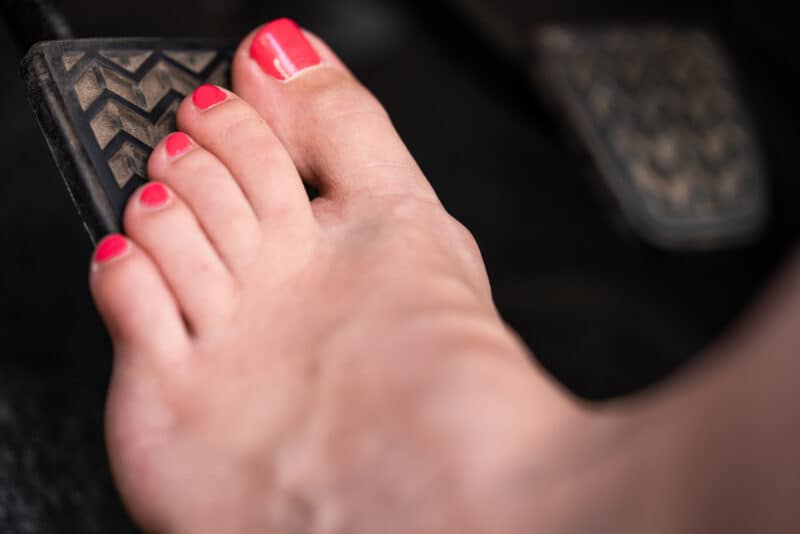
Bare foot resting on a car pedal

No, it is not illegal to drive barefoot in any U.S. state. No federal or state law prohibits operating a vehicle without shoes. However, if you are involved in an accident while barefoot, police or insurance companies may argue that your footwear contributed to the crash, which can affect fault and your compensation.

A few points that affect how this plays out on the road:
  • Legal in all 50 states: no federal law and no state law bans barefoot driving for car drivers.
  • Alabama’s exception is motorcycle-only: the one footwear law on the books applies to motorcycle riders, not passenger vehicle drivers.
  • Some states discourage it without banning it: Ohio, Nevada, and Indiana advise against barefoot driving but do not make it a ticketable offense for drivers.
  • Often safer than the alternative: several state police agencies say bare feet offer better pedal control than flip-flops or high heels.

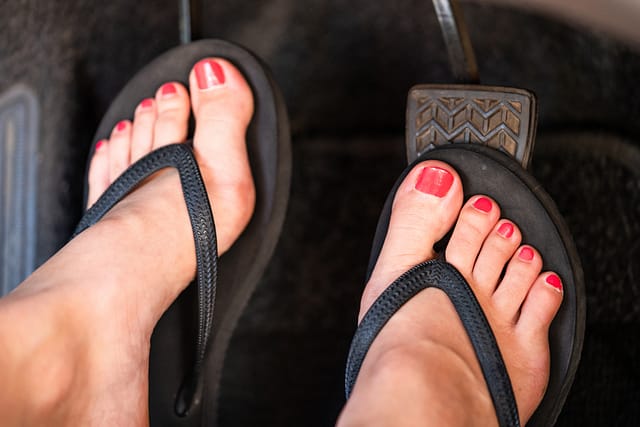
Person wearing flip-flops with one foot on a car gas pedal

Is Driving Barefoot Dangerous?

Driving barefoot is not categorically dangerous. The risk depends on the conditions, and treating it as a blanket hazard misses what actually matters.

  • Wet feet are the real risk: if you are coming from the beach, a pool, or any wet surface, dry your feet before driving. Wet skin on a pedal reduces grip and slows your reaction on hard braking.
  • Pedal type affects grip: metal pedals offer less traction for bare feet than rubberized pedals, so extra caution is warranted in vehicles with metal pedals on wet days.
  • Dry bare feet can outperform dress shoes or heels: slick soles and heels reduce pedal feel and change the angle your foot makes contact with the brake. A dry bare foot keeps full contact and gives direct feedback on pedal pressure.
  • Loose shoes left on the floorboard are a separate hazard: if you drove in and kicked off your shoes, make sure they are not near the pedals. A shoe that slides under the brake is a bigger risk than driving barefoot itself.
  • Most driving conditions pose no elevated risk: on dry roads, bare feet perform comparably to flat-soled shoes and better than several common footwear choices.

Barefoot driving is a low-risk choice in most circumstances. Wet feet are the one condition that genuinely raises the risk, so take a minute to dry off before driving if you are coming from the beach or a pool.

Is Driving Barefoot Legal in Every State?

Yes, barefoot driving is legal in all 50 states for passenger vehicle operators. The clearest confirmation came in the 1990s, when Jason Heimbaugh wrote to the DMV of every U.S. state asking directly whether barefoot driving was prohibited. Every state confirmed it was not, and no law has changed that since.

What the law says

  • Alabama’s law applies to motorcycles, not cars: under Alabama Code Section 32-5A-245, motorcycle riders must wear shoes. Passenger vehicle drivers are not covered.
  • Missouri and Michigan have gone on record: the Missouri State Highway Patrol and Michigan State Police have both stated that bare feet can offer better pedal control than certain footwear alternatives.
  • Local ordinances are rare but possible: a small number of municipalities may have their own rules. If you drive in an area with strict local codes, it is worth a quick check before assuming state law covers everything.

Why Do People Think Driving Barefoot Is Illegal?

The myth has no legal basis. No federal agency has ever banned barefoot driving, no state legislature has passed a law against it for car drivers, and no court has upheld a conviction for it. The belief persists because discouraging something and prohibiting it are two very different things, and that line gets blurred fast.

Where the myth comes from:

  • Generational misinformation: parents told their kids it was illegal, driver’s ed instructors repeated it as fact, and the idea spread without anyone checking the statute.
  • Advisories get misread as law: when a state agency discourages barefoot driving, some people interpret that as a ban. An advisory carries no legal weight and creates no ticketable offense.
  • Officers who get it wrong: some officers are not aware that barefoot driving is legal and may issue a citation anyway. Those tickets can be challenged in court because no law supports them.

If you receive a ticket for driving barefoot, do not assume the officer is correct. Look up your state’s vehicle code, find the statute number the ticket references, and consult a lawyer if no statute applies.

Barefoot Driving vs. Flip-Flops and Unsafe Footwear

Bare feet get the scrutiny, but flip-flops cause more documented problems behind the wheel. The reasons are mechanical, not theoretical.

The footwear that creates real risk:

  • Flip-flops: the sole can wedge under the brake or gas pedal, the strap can prevent a full press, and the shoe can flip off entirely mid-drive. That sequence takes less than a second and leaves you with no pedal control at the worst possible moment.
  • High heels and wedges: the elevation shifts the angle at which your foot contacts the pedal, reducing surface contact and making precise braking harder. A heel that catches the floor mat compounds the problem.
  • Shoes with long laces: loose laces can loop around the pedal base and restrict foot movement without the driver noticing until a hard brake is needed.

Bare feet eliminate all three of those failure points. Your foot sits flat on the pedal, contact is direct, and there is nothing to catch, flip, or shift angle.

A person riding a motorcycle barefoot near the beach

Can Barefoot Driving Affect Your Insurance Claim or Fault Determination?

Barefoot driving is legal, but legal does not mean liability-free. Insurance adjusters and opposing counsel look for any factor that shifts fault away from their client, and your footwear at the time of the crash is fair game. You broke no law, but that argument alone may not be enough to protect your full compensation.

What can happen after an accident:

  • Police report notation: if the responding officer notes “no footwear” in the report, the insurer can cite it as a contributing factor to the crash, even without a citation.
  • Comparative negligence argument: adjusters may argue that barefoot driving contributed to delayed braking or loss of pedal control, which under comparative negligence rules can reduce your compensation proportionally.
  • Ohio and Nevada go further: both states explicitly allow officers to issue citations if they believe the lack of footwear contributed to a crash. A citation in either state creates a direct record that insurers will use.
  • Civil liability exposure: if the other party sues, barefoot status can be raised to argue partial fault. How that argument lands depends on how fault is determined in your state and the specific facts of the crash.
  • Types of damages at stake: a successful comparative fault argument reduces the compensation you can recover, including medical bills, lost wages, and pain and suffering.
  • Do not volunteer footwear information: at the scene or in conversations with adjusters, you are not required to disclose what you were wearing. Anything you say can be used to build a fault argument against you.

Insurers raise barefoot driving as a fault factor more often than most people expect.

When to Contact a Lawyer After a Car Accident

Contact a lawyer if an insurer is using your barefoot status against you, if the other driver is blaming your footwear, or if your settlement offer feels low or fault is disputed. These situations happen across Texas and in cities like Fort Worth, and knowing what to do after a car accident before you talk to an adjuster is the difference between a fair settlement and a reduced one.

  • The insurer is citing your barefoot status: if an adjuster mentions your footwear in any conversation about fault or settlement, stop negotiating on your own.
  • The other driver is blaming your footwear: a claim that your bare feet caused or contributed to the crash is a comparative fault argument. It needs a legal response, not just a denial.
  • The settlement offer is low, or fault is disputed: early offers rarely reflect the full value of a claim. An attorney reviews what damages you are owed before you sign anything.

Get a Free Case Review From a Personal Injury Lawyer

Thompson Law offers a Free Consultation to review your claim, push back on insurer fault arguments, and make sure your barefoot status does not cost you compensation you are owed. No Fee Unless We Win your case. Contact us to speak with a personal injury lawyer about your case.

Person on the phone writing on documents at a desk with a scale of justice

Frequently Asked Questions

Is it illegal to drive barefoot in the United States?

No. Driving barefoot is legal in all 50 states. No federal law and no state law prohibits operating a passenger vehicle without shoes. The only footwear law in the country applies to motorcycle riders in Alabama, not car drivers.

Can you get a ticket for driving without shoes?

In most states, no. Ohio and Nevada allow officers to issue a citation if they believe barefoot driving contributed to a crash. Outside those circumstances, no statute supports a ticket for barefoot driving. If you receive one, it can be challenged in court.

Is it safer to drive barefoot or in flip-flops?

Barefoot is safer. Flip-flops can wedge under pedals, prevent a full brake press, or flip off mid-drive. Missouri State Highway Patrol and Michigan State Police have both stated on record that bare feet offer better pedal control than certain footwear alternatives.

Can insurance blame me for an accident if I was barefoot?

Yes, they can try. Insurers and opposing counsel can raise barefoot status as a comparative fault argument even though no law was broken. If an adjuster mentions your footwear, stop negotiating on your own and contact a lawyer.

Is it illegal to drive barefoot in Texas or Florida?

No, it is legal in both states. Neither Texas nor Florida has a law prohibiting barefoot driving for passenger vehicle operators. The same rules apply as in every other state: legal to drive barefoot, but footwear can still be raised as a fault factor after a crash.

¿Atienden casos en español?

Sí. Atendemos casos en español en todo el país. Contáctenos para una consulta gratuita. Revisamos su caso, le explicamos sus opciones y no cobramos a menos que ganemos.

Recent Post

Person documenting a car accident scene with a mobile phone, taking photos of vehicle damage and evidence for an insurance claim

What to Do After a Car Accident in Texas

Knowing what to do after a car accident in Texas can help you protect your health, your legal rights, and your insurance claim from the very beginning. Even a minor

Read More

Judge’s gavel representing the personal injury claims process after a car accident

Personal Injury Claim Process After a Car Accident in Texas

The personal injury claim process after a car accident typically involves medical treatment, opening an insurance claim, investigating fault and damages, negotiating a settlement, and, if needed, filing a lawsuit.

Read More

Car Wreck Lawyer - Augusta Personal Injury Lawyers

When To Get A Car Wreck Lawyer

Following a car accident, you may be asking yourself, “When do I need a car wreck lawyer?” The answer: It is always worth contacting a car accident attorney. Start by

Read More

Two people in business attire shaking hands over a desk with a wooden gavel and documents in the foreground.

Illinois Personal Injury Claim Process: Steps, Deadlines, and How to Protect Your Case

The personal injury claim process in Illinois involves seven key steps: seek medical care, report the incident, gather evidence, hire an attorney, send a demand letter, negotiate with the insurer,

Read More

Two people signing documents on a desk with a small red car model and car keys visible nearby.

Insurance Company Tactics in Illinois Accident Claims: How They Delay, Deny & Devalue Your Case

Insurance companies in Illinois rely on insurance company tactics like delaying investigations, lowballing settlements, disputing injuries, requesting recorded statements, and monitoring social media to reduce or deny payouts. Under Illinois

Read More

Wooden gavel resting on a stack of cash bills on a wooden surface

How Much Is My Injury Case Worth in Illinois? What Affects Your Settlement and How to Estimate It

An Illinois injury case's value depends on the severity of your injuries, your medical expenses, lost wages, and whether you share any fault. Minor injuries typically settle between $10,000 and

Read More

Thompson Law Guarantee

Thompson Law charges NO FEE unless we obtain a settlement for your case. We’ve put over $2.1 billion in cash settlements in our clients’ pockets. Contact us today for a free, no-obligation consultation to discuss your accident, get your questions answered, and understand your legal options.

State law limits the time you have to file a claim after an injury accident, so call today.